A bizarre incident in Grapevine has gone viral after a man allegedly drove his Tesla Cybertruck directly into a lake to test the vehicle’s much-discussed cybertruck wade mode feature. What was supposed to be a demonstration of futuristic vehicle capability quickly turned into a rescue operation involving police officers and water rescue teams.
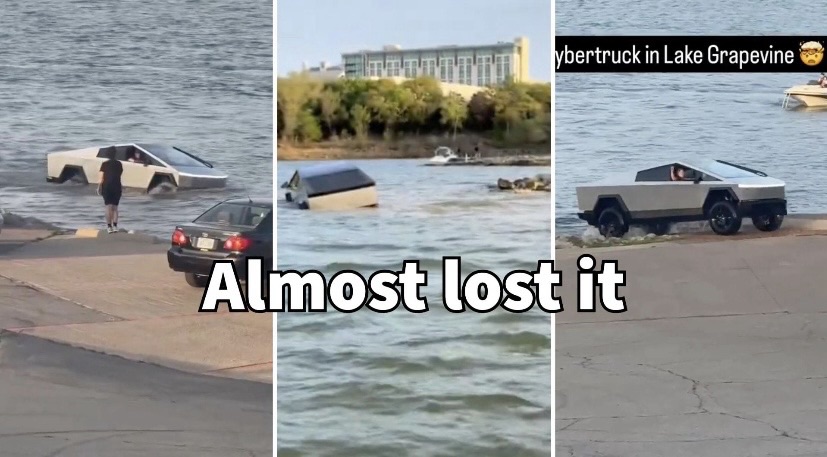
According to the Grapevine Police Department, the driver intentionally entered Grapevine Lake near Katie’s Woods Park Boat Ramp in an attempt to activate the cybertruck wade mode setting. Witnesses recorded the expensive electric truck partially submerged near the shoreline before emergency crews arrived at the scene.
The cybertruck wade mode feature is designed to help the Tesla Cybertruck navigate shallow water crossings such as creeks and flooded roads. According to Tesla’s manual, the feature temporarily raises the suspension and pressurizes the battery system to protect the vehicle while driving through water. However, Tesla clearly warns users that the maximum safe water depth is around 32 inches and advises drivers to assess water conditions carefully before attempting any crossing.
Unfortunately for the driver, the cybertruck wade mode experiment failed almost immediately. Police said the vehicle began taking on water and became disabled inside the lake. Both the driver and passenger reportedly escaped through the window and swam back to shore before the vehicle sank deeper into the water. The Grapevine Fire Department Water Rescue Team later assisted in removing the Cybertruck from the lake using specialized recovery equipment.
Authorities later identified the driver as Jimmy Jack McDaniel, a 70-year-old Texas resident. Following the failed cybertruck wade mode attempt, he was arrested and charged with operating a vehicle in a restricted section of the lake, failing to have valid boat registration, and violating multiple water safety equipment regulations under Texas law. Reports indicate that he spent at least one night in jail following the incident.
The legal punishment connected to the cybertruck wade mode incident could become costly. In Texas, violations involving unauthorized operation in restricted lake areas and water safety offenses can result in fines, misdemeanor charges, court appearances, towing expenses, and possible compensation for emergency rescue operations. Depending on how prosecutors proceed, the driver could also face civil liability if public resources were unnecessarily used during the rescue mission.
The incident has also sparked debate online about whether Tesla’s marketing around the cybertruck wade mode feature encourages reckless behavior. While some social media users mocked the failed experiment, others pointed out that Tesla’s owner manual explicitly warns against driving into deep or unpredictable bodies of water. Tesla also states that water damage caused by misuse of the feature may not be covered under warranty.
What makes the story even more shocking is that this was not a spontaneous accident. Police say the driver openly admitted that he intentionally drove into the lake specifically to test the cybertruck wade mode capability. Authorities used the incident to remind drivers that even advanced vehicle technology does not override local laws or basic safety rules.
The failed cybertruck wade mode stunt now stands as one of the most talked-about Tesla incidents of the year. While modern electric vehicles continue to push technological boundaries, experts say this situation highlights an important reality: features designed for limited off-road assistance should never be mistaken for permission to drive directly into lakes.
Officers responded to the Katie’s Woods Park boat ramp, located off Katie’s Woods Drive, around 8 p.m. They arrived and found the Cybertruck in the lake near the shoreline.
The department said the driver, Jimmy Jack McDaniel, told them he intentionally drove the vehicle into the lake to try and use its “Wade Mode” feature. However, the Cybertruck was disabled and took on water, police said, prompting the driver and a passenger to abandon it.
The vehicle was removed with the help of the Grapevine Fire Department’s Water Rescue Team.
Police said McDaniel remains in jail as of Tuesday, charged with operation of a vehicle in a closed section of the lake, not having a valid boat registration and other water safety equipment violations.
The department reminds drivers that while a vehicle may be physically capable of entering shallow freshwater areas, doing so could create legal and safety concerns under Texas law.
Can a Cybertruck safely enter a lake? According to Tesla’s online owner’s manual for the Cybertruck, Wade Mode “allows Cybertruck to enter and drive through bodies of water, such as rivers or creeks”. However, the manual warns that drivers have a responsibility to “gauge the depth of any body of water before entering”, and that damage to the vehicle as a result of driving in water is not covered by the warranty.
Additionally, the manual tells owners they need to check water conditions before entering and to use best judgment. The manual also notes the maximum wade depth for a Cybertruck is about 32 inches, measuring from the bottom of the tire.
The manual also warns Cybertruck drivers that soft or muddy underwater surfaces can cause the vehicle to sink, increasing the water level on it. Drivers are also warned against driving in strong currents or rapids.